
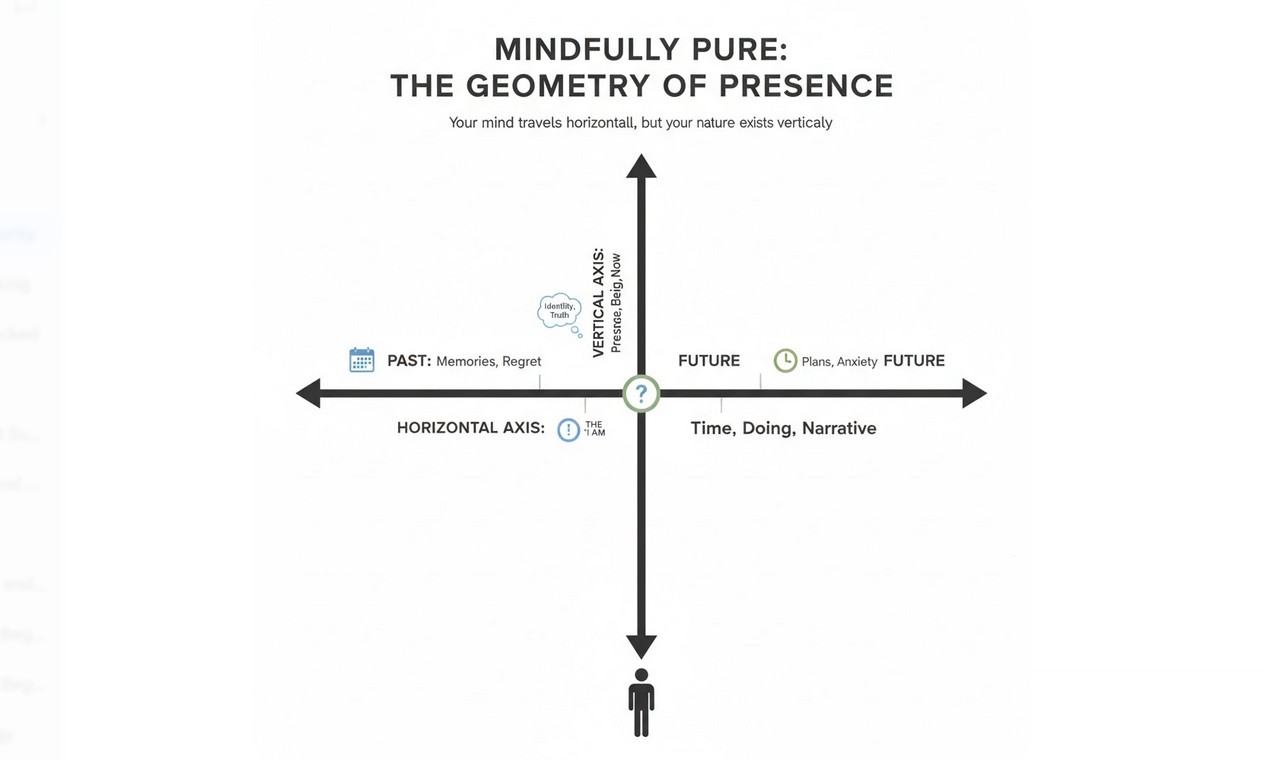
Key Insight: The “No-Self” Reality Most people define themselves through the “horizontal” axis of time, a collection of past memories and future anxieties. In reality, your true identity is the “vertical” presence, the silent observer that exists beneath the stories. By stripping away what you were and what you will be, you don’t disappear; you finally encounter the only part of you that is permanent: the “I Am” of the present moment.
If your memories vanished and your future plans dissolved, who would you be, right now?
Without past or future, you are pure presence, the silent, unchanging awareness that remains once the mental narrative of time is stripped away.
Most of us define ourselves by what we’ve done or what we hope to do, the job title, the achievements, the regrets, the goals. But those are all stories tied to time. The past weighs us down with memory, the future pulls us into worry or anticipation.
Strip both away and the tightness you feel in your chest, shoulders and neck begins to fade, you can literally feel the tension of yesterday’s regrets and tomorrows ‘to-do list’ slowly evaporate as you sit a little straighter and finally breath out.
“Your own Self-Realization is the greatest service you can render the world.” – Ramana Maharshi
This article explores that shift and offers a simple guided exercise I have personally used that can be used anytime to return to your true self.
Key Takeaways
- The Identity Trap: We suffer because we mistake our “biography” (past) and our “destiny” (future) for our “identity.”
- Presence is Not a Void: Removing the past and future doesn’t leave you empty; it reveals the “substrate” of consciousness that was always there but obscured by mental noise.
- Memory vs. Truth: Memories are useful tools for navigation, but they are “dead” energy. Truth is found only in “live” energy—the sensations occurring right now.
- The Power of the Vertical: While the “horizontal” life deals with doing, the “vertical” life deals with being. Shifting your focus to the vertical axis ends the constant need for “becoming.”
- Freedom from Narrative: When you stop needing to be “someone” with a history, you gain the freedom to be “everything” in the present.
The Question: Who Am I Without Past or Future?
The question, “Who am I if I don’t have a past or a future?” slices through the layers of identity we carry and begins to expose who it is you truly are.
Think about it:
- The past is a mental scrapbook of moments, lessons, and wounds that tell us who we were.
- The future is an imagined canvas of fears and dreams, full of what we might become.
Both are constructs of thought. Our past is a collection of stories, moments of joy, pain, or lessons that shape how we see ourselves right now. The future is a canvas of hopes, fears and plans we hope happen adding even more weight to the thoughts.
Both are constructs of the mind, thoughts that often change and can come and go in moments pulling us away from the now. But when we let them fall away, we ‘re able to glimpse a deeper reality: presence. Here, you are not your memories or your ambitions. You are simply aware, alive, and free.
“Realize deeply that the present moment is all you ever have. Make the Now the primary focus of your life.” – Eckhart Tolle
To grasp this, you must step out of the mind’s tendency to label, analyze, or project. Instead, you allow yourself to simply be. This isn’t an idea to debate or analyze, it’s something to feel directly. The true self exists only here, in the freshness of now.
The Trap of Words and Time
The mind will always try to answer “Who am I?” with labels, my name is Bill, I am 58 years old and I write for MindfullyPure.com. But all of those concepts are trapped in time because words are bound by time. As soon as ‘rational thought’ enters the equation, you’re are out of the present moment and in your thoughts.
Think of it like this, have you ever been deep in thought and someone or something startles you? At first you look around, you don’t even know where you are, but for a second, you are in the present moment, it’s your brain that is trying to catch up and label the world so it feels safe, the real you never feels fear.
The true self is not a definition, which is why it is so hard for the thought mind to grasp and why it literally can not. It’s the quiet space beneath thought, the awareness that remains when we stop labeling and simply are. This is why no one, even your own mind, can give you the answer in words. It must be experienced in silence, in the pause between thoughts.
It’s not a puzzle to solve but a state to experience. The moment you feel it, you understand. But to reach this understanding, you must let go of the need to name or categorize. You must immerse yourself in the present moment.
A Guided Exercise to Experience Presence
Here’s a simple practice you can try. It can take 10 to 15 minutes, but even two minutes is enough to begin and start to understand the difference between who you think you are and who you really are.
Step 1: Settle In
Find a quiet space. Sit comfortably. Close your eyes if it feels natural. Take a few deep breaths, noticing the weight of your body, the sensation of breath moving in and out.
Step 2: Release Past and Future
Ask yourself: “Who am I without my past or future?”
Imagine memories, regrets, plans, and expectations dissolving like mist. If they reappear, simply notice and let them pass.
Step 3: Feel the Now
Bring your attention to what is happening right here: your breath, the heartbeat, the sounds around you. Don’t label them, just notice the raw experience of being alive.
Step 4: Observe Without Naming
The mind may try to analyze. That’s okay. Gently ask: “What is this moment without my thoughts about it?” Then return to the direct experience of presence.
Step 5: Rest and Return
Stay with this awareness as long as feels comfortable. When ready, take a deep breath and open your eyes, carrying that sense of presence into the rest of your day.
Quick Version: Pause for three breaths before checking your phone, eating, or walking into a room. Notice “I am here, now.” That’s it.
Reflections on the Experience
This exercise is not about achieving a goal or finding a definitive answer. It’s about discovering what it feels like to exist without the filters of time. Some people feel peace, clarity, or expansiveness. Others feel nothing at all. Both are fine.
Presence is not about dramatic experiences, it’s about gently shifting from mental stories to direct awareness.
“Do not dwell in the past, do not dream of the future, concentrate the mind on the present moment.” – The Buddha
If you find your mind wandering back to thoughts or labels during the exercise, that’s okay. Each time your mind drifts and you return, you strengthen your capacity to live from this deeper place. It’s like building a muscle of awareness.
It took me months of meditation before I could simply be without mental chatter. It sounds so easy, but with today’s rushed and buzzing lifestyle, it’s not as easy as gurus make it seem. But I did do it, and so can you. It just takes patience and repetition, nothing more or less.
The Practical Paradox
When I first tried this exercise many years ago, the voice in my head was saying things like, “But I need my past to learn from mistakes!” or “I need my future to pay my bills!”
And guess what, your brain is correct, you do need those things to exist in today’s society. But what many don’t understand is memory is a tool (a map), but it isn’t the territory (you).
Think of it like this, you are cooking and you burn you hand with some hot oil. It’s a painful memory and one you wish you didn’t have. Now, you still cook, you just don’t make that same mistake again. But do you need to recall that memory every time you want to fry an egg? Of course not. The information is always there, but it doesn’t need to be brought into the present moment in order to learn from it again and again.
Although some people do do this, like the person who was left by their lover and sees them in every other suitor. And what happens, at the end of the day they feel alone and hurt. Not because the experience is happening again, but because they choose to experience that pain rather than the actual present moment, which is completely benign.
Living in Presence
Most mindfulness teaches you how to manage the past and future; ‘Vertical Living’ teaches you that the past and future are merely echoes, while Presence is the only living source.
Asking “Who am I without past or future?” is not a puzzle to solve but a doorway to living differently. You’ll still use memory and planning for practical things, but they no longer define you.
Your true self is always here, in the living moment. With practice, presence stops being an “exercise” and begins to feel like home. Life becomes clearer, fresher, more alive.
Try this daily, even briefly. Journal your experience for a week. Notice the small but powerful ways your perception shifts.
When you return to presence again and again, you aren’t becoming someone new, you’re remembering who you already are.
A Few Common Questions…
Can I really exist without my past memories?
Yes. While your social identity and personality rely on memory, your core consciousness does not. You are the one observing the memories. When memories are momentarily set aside, you experience the “I Am” that exists prior to any story.
Why does focusing on the future cause suffering?
The future is a mental construct of “what might be.” When you define yourself through the future, you are always in a state of “becoming” rather than “being.” This creates a permanent gap between where you are and where you think you should be, leading to chronic anxiety.
What is the difference between the “horizontal” and “vertical” life?
The horizontal life is the world of time, doing, and biography—it’s where your “story” lives. The vertical life is the world of depth, presence, and being. Most people live exclusively on the horizontal axis; mindfulness is the practice of dropping into the vertical “now.”
A Call to Presence: “Pause now. Close your eyes. Who are you, right now?”

Bill writes for people who value clarity over comfort and depth over doctrine.
His work explores spirituality without dogma, mindfulness without performance, and truth grounded in lived experience. Drawing from Buddhist, early Christian, and Hindu contemplative traditions, alongside modern psychology, he focuses on what can actually be felt, practiced, and integrated into daily life.
Mindfully Pure is for those who are spiritual but not religious, curious but discerning, and seeking insight without losing their footing in the real world.