
Key Insight: The Attachment Myth Most mindfulness advice suggests that “letting go” means severing emotional ties or becoming indifferent. In reality, true non-attachment isn’t about pushing feelings away, it’s about changing your relationship to them so they no longer control your inner peace. This post explores why forcing “detachment” often backfires and how to find freedom through presence instead.
Key Takeaways
- Objects are Containers, Not Sources: We don’t suffer because a car is gone or a relationship ends; we suffer because the “identity” and “story” we built around those things have vanished.
- Attachment is a Projection: Meaning, pride, and success are emotions we project onto objects. The object is just a mirror; the feeling lives in your own mind and nervous system.
- The “Mistake of Ownership”: Freedom isn’t living without things; it’s living without the mistaken belief that those things are us. You can wash the car and love the person without asking them to hold up your entire sense of self.
- Desire Destroys the Present: Whether an event (like a rainy wedding) is a disaster or a memory depends on our internal demand for a specific script. Letting go of the “blueprint” allows us to find joy in what is actually happening.
- The Practice of “Borrowed” Living: By treating possessions and relationships as “borrowed” from the universe, we can care for them deeply while accepting their natural decay or departure without “leaving a scar.”
In this article, we’ll explore the essence of letting go of attachment, drawing from my own personal insights to reveal how it leads not to deprivation, but to genuine enjoyment of life’s fleeting wonders.
The Myth of Letting Go of “Things”
At the heart of this teaching is a crucial distinction, attachment isn’t about the objects themselves, but our relationship to them. Many people assume that to “let go” means to physically or mentally abandon possessions, people, or experiences.
If attachment were tied solely to the thing, we could simply discard it and move on. Yet, life doesn’t work that way. We’ve all lost something, a cherished item, a loved one, or a moment and found ourselves haunted by thoughts of it long after it’s gone. This lingering proves that attachment runs deeper than the object.
It’s more about the feelings the objects bring us rather than the things. Think of it like this, if you have a 1969 Mustang GT 500, it might be your ‘baby.’ You wash it every day, you give it the best gasoline and you love the looks you get as you roar by people in the street admiring the car.
But then it gets stolen. It’s gone and you’re devastated. Why? Not because you can’t go out and buy another car, even a better one (yes, if you’re a Mustang lover you’re probably cringing), but that’s not the problem, the attachment is. But when you really drill down and look, the attachment isn’t really the car at all.
Rather, it’s the identity wrapped around it.
- It’s the story of who you were when you drove it.
- The sense of pride.
- The feeling of being seen.
- The memory of freedom, success, youth, or arrival.
The car was never the source. It was the container.
This is why simply removing an object that brings pain or negative feelings rarely brings peace. You can give away the car, leave the relationship, quit the job, move to a new country and still feel the same ache follow you. The mind keeps replaying the feeling it associated with that thing, hoping to reclaim it.
In Buddhist terms, attachment is not clinging to form, but clinging to the experience we believe the form provided. The mistake is thinking the feeling lived in the object, rather than recognizing it arose through our own mind and nervous system.
So “letting go” is not an act of rejection or renunciation. It’s an act of clarity.
It’s seeing:
- The joy didn’t come from the car.
- The love didn’t come from the person.
- The meaning didn’t come from the role or the title.
Those things were mirrors, not sources.
The car gave you permission to feel pride, you were ‘the guy who had the cool classic car.’ You allowed yourself to feel powerful driving down the street, and admired to have such a beautiful thing in your life. These are emotions, not realities.
You don’t change when the car is gone, only the story you tell about who you are does. If the car is stolen, you now have no self ideal to cling to since the object is gone, and so you suffer. The car isn’t making you suffer, you are. You are feeling the loss, the car has no idea!
When this is understood, something subtle shifts. You no longer need to destroy, suppress, or run from objects or experiences. You can enjoy them fully, wash the car, love the person, savor the moment without asking them to hold up your sense of self.
This is the quiet freedom of what I am pointing toward.
Not a life without things,
but a life without mistaken ownership of the feelings they temporarily awaken.
You don’t let go of the thing.
You let go of the belief that it was ever what you were really holding onto.
Attachment isn’t to things, but to the feelings, identity, and meaning we project onto them.
As humans, we can’t truly escape “things.” We rely on them for survival and comfort. Our own bodies are things, and they’re always in contact with something.
Standing? You’re touching the ground. Sitting? Your clothes brush against your skin. Even if you tried to float naked in space to avoid all touch, you’d still be attached to your own body, an object in itself. This illustrates the impossibility of complete detachment from the material world.
Buddhism doesn’t ask us to escape the material world. It asks us to stop mistaking it for the source of who we are. We will always touch things. The practice is learning not to cling to the meaning we project onto that touch.
Buddha’s Wisdom: Desire, Not the World, Is the Culprit
In a key verse from Buddhist scripture, the Buddha states:
“They are not sensual pleasures, the pretty things in the world. A person’s sensual pleasure is a lustful intention. The pretty things remain just as they are in the world. But the wise remove the desire for them.”
Here, the Buddha affirms that the world’s beauties, the flowers, landscapes, art, and relationships aren’t the problem. They should remain as they are, undisturbed and appreciated.
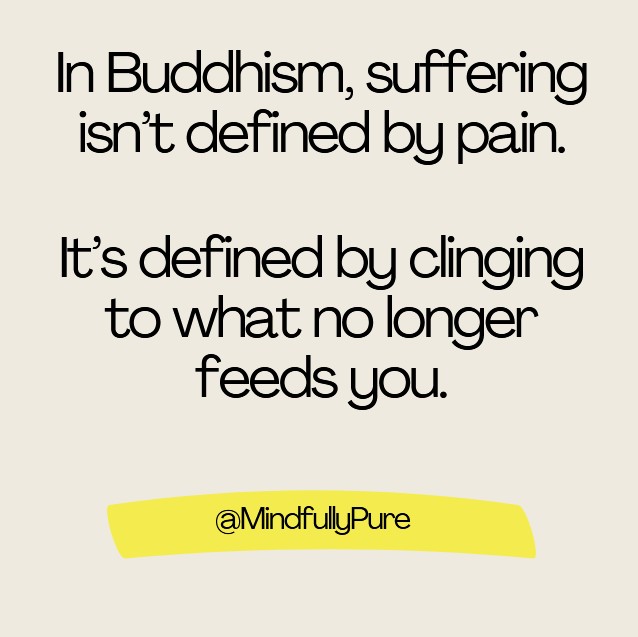
What we must release is the “lustful intention,” that grasping “desire” to possess, control, or make them permanent. Desire transforms innocent enjoyment into suffering by imposing expectations that the world can’t fulfill, nor does it have the responsibility to do so just because that is what you desire.
Let the pretty things be and don’t destroy their essence by trying to hoard or change them in some way to align with your expectations. Instead, cultivate wisdom by stripping away the craving that clouds our perception to see things as they are.
How Desire Destroys Beauty and How Letting Go Restores It
Paradoxically, it’s only by letting go of desire that we can truly savor life’s offerings. Desire, as the Buddha defines it, is the urge to claim something as “mine,” to freeze it in time and resist its natural evolution. This clinging leads to disappointment because everything in the universe is impermanent, subject to change, decay, and transformation.
Let’s take something simple for clarity. Imagine your wedding day. You’ve planned for months, but you wake up to a hurricane. The decorations are in the mud. You have two choices: you can see the day as “ruined” because the reality doesn’t match your blueprint, or you can “dance in the rain.”
This doesn’t mean you aren’t disappointed. It means you recognize that the rain has no “intent” to hurt you. The rain is just raining. The suffering doesn’t come from the water, it comes from the demand that a cloud should behave differently for your sake.
When you release the expectation, you are free to find a dry room, gather the people who are already there, and celebrate the love that the weather can’t touch. You stop asking “Why me?” and start asking “What is actually happening right now?”
Free from the burden of expectations, we can fully immerse ourselves in the moment, appreciating the world’s transient splendor.
From the Mountain to the Mud: Applying Non-Attachment Today
It is easy to feel unattached while standing on a mist-covered peak in Sri Lanka. It is much harder when your phone screen shatters, a promotion goes to a colleague, or a partner says something that stings.
To move this wisdom from a philosophy into a practice, we have to apply it to the “mud” of daily life. Here are three ways I have found personally useful to practice the “unattached gaze” in real-time:
The Five-Second Pause: When you feel the “lustful intention” to buy something impulsively or win an argument at any cost, pause for five seconds. Ask yourself: “Am I reaching for joy, or am I reaching for control?” The goal isn’t to become a person who doesn’t care.
The goal is to become a person who cares so deeply for the present moment that they don’t need to kidnap it and hold it hostage. As the monk suggests, happiness isn’t found in a world without “things,” but in a heart that lets those things pass through without leaving a scar.
The “Borrowed Object” Mindset: Treat your most prized possessions, your home, your car, even your favorite mug as things you are simply “borrowing” from the universe. When we view things as borrowed, we care for them deeply, but we aren’t shocked when they eventually break or go missing.
The “Visitor” Technique for Relationships: When a loved one is acting in a way that frustrates you, realize you are trying to “clasp the rabbit.” You are demanding they stay frozen in a version of themselves that makes you comfortable. Instead, view their changing moods as the “mist on the mountain,” temporary, natural, and not yours to control.
Letting go, then, is not an act of loss. It is an act of intimacy with life as it actually is. When desire loosens its grip, the world doesn’t fade, it becomes more vivid. We stop trying to own the moment and finally learn how to live inside it.
Frequently Asked Questions
What is the biggest myth about “letting go” of attachment?
The biggest myth is the belief that letting go requires you to physically get rid of possessions or become emotionally indifferent to people. In reality, letting go is an internal shift. It is about releasing the mistaken belief that an object, person, or status is the source of your identity or happiness, rather than just a “container” for your own internal feelings.
Does non-attachment mean I shouldn’t own nice things?
Not at all. As the Buddha taught, “pretty things” are not the problem, lustful intention and grasping desire are. You can own a classic car, a beautiful home, or a successful business and enjoy them fully. Non-attachment simply means you stop asking those things to provide a permanent sense of “self” that they are incapable of sustaining.
How can I practice letting go of attachment in a relationship?
Practice the “Visitor Technique.” Recognize that your partner is a sovereign being whose moods and actions are like “mist on a mountain,” temporary and beyond your control. When you stop trying to force them to fit a specific “blueprint” for your comfort, you actually become more intimate with who they truly are in the present moment.
Continue Your Journey…
Letting go of the myth is only the first step. To discover the peace that remains when the stories fall away, I invite you to read: Who Am I Without Past or Future?

Bill writes for people who value clarity over comfort and depth over doctrine.
His work explores spirituality without dogma, mindfulness without performance, and truth grounded in lived experience. Drawing from Buddhist, early Christian, and Hindu contemplative traditions, alongside modern psychology, he focuses on what can actually be felt, practiced, and integrated into daily life.
Mindfully Pure is for those who are spiritual but not religious, curious but discerning, and seeking insight without losing their footing in the real world.